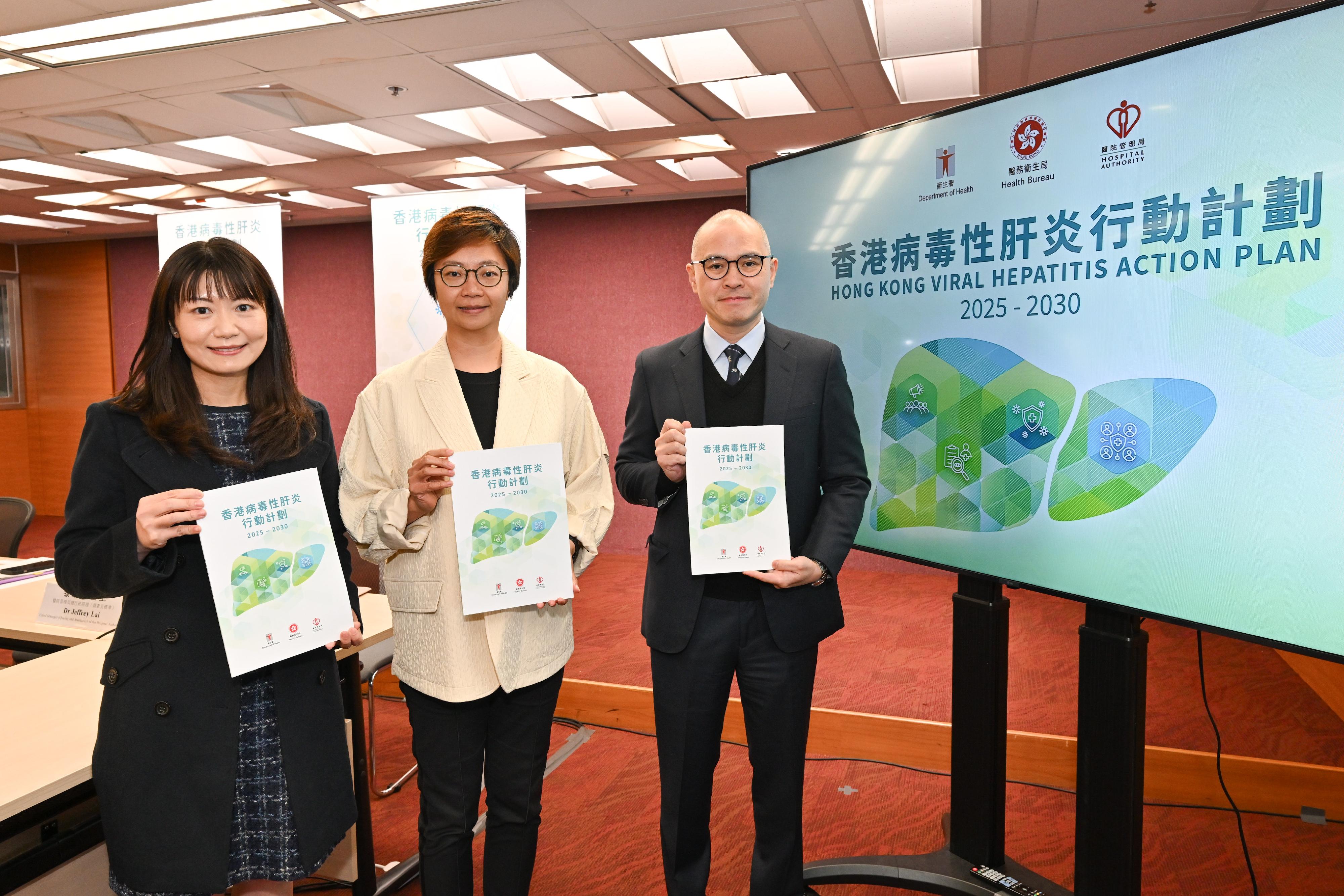



Government promulgates Hong Kong's second viral hepatitis action plan covering rollout of pilot hepatitis B screening programme, to progress towards goal of eliminating public health threat posed by viral hepatitis (with photo)
******************************************************************************************
According to data from the Hong Kong Cancer Registry, liver cancer is the third-leading cause of cancer deaths in Hong Kong. In 2023, there were 1 408 liver cancer deaths, accounting for 9.5 per cent of all cancer deaths. Over 70 per cent of hepatocellular carcinoma cases were associated with hepatitis B.
The Government has attached great importance to the public health threat posed by viral hepatitis. As early as late 2020, the Steering Committee on Prevention and Control of Viral Hepatitis (Steering Committee), co-chaired by the Director of Health and the Chief Executive of the Hospital Authority (HA), formulated the Hong Kong Viral Hepatitis Action Plan 2020-2024 (Action Plan 2020-2024).
Over the past five years, the Government has fully implemented all measures outlined in the Action Plan 2020-2024, achieving substantial progress. Through the introduction of new initiatives, including providing antiviral treatment for pregnant women with high hepatitis B virus (HBV) viral loads and arranging serologic testing after hepatitis B vaccination for high-risk infants, the rate of mother-to-child transmission (MTCT) of HBV in Hong Kong dropped to 0.2 per cent in 2024, which is well below the pre-intervention level of approximately 1 per cent.
After carefully reviewing the effectiveness of the action plan and the latest international developments, the Steering Committee has clearly set out specific actions to be implemented in the next five years. In addition to the Department of Health (DH) and the HA, the Action Plan 2025-2030 also incorporates the Primary Healthcare Commission (PHC Commission) and other relevant organisations for more comprehensive coverage and stronger synergy.
The major challenge in eliminating viral hepatitis lies in the substantial number of the undiagnosed or untreated local population with hepatitis B. It is estimated that approximately 410 000 people in Hong Kong have hepatitis B. Among them, 40 per cent are unaware of their condition and 70 per cent are not receiving appropriate medical follow-up. The Action Plan 2025-2030 strengthens efforts to prevent and control viral hepatitis along the following four strategic axes:
(1) Heightening awareness: The collaborative partnerships and engagement with District Health Centres and other community stakeholders will be strengthened, leveraging the complementary strengths of each organisation to raise awareness among the general population, target populations and healthcare professionals. This will support viral hepatitis screening and management in the community;
(2) Tracking health sector response: The set of local indicators will be updated to enhance the existing surveillance on viral hepatitis, allowing for closer monitoring and evaluation of progress towards viral hepatitis elimination targets. The surveillance system will support data-driven policy formulation by providing a basis for developing specific and effective measures, and offering data to validate the effectiveness of the health sector's response;
(3) Preventing new infections: The primary transmission route for HBV is MTCT, which drives the prevalence of HBV in Hong Kong. Therefore, sustained prevention of MTCT of HBV is crucial for eliminating new HBV infections. This includes hepatitis B screening for pregnant women, neonatal hepatitis B vaccination, using antivirals to prevent MTCT of HBV and arranging post-vaccination serologic testing for high-risk infants. Other prevention strategies include preventing healthcare-related transmission of HBV and hepatitis C virus and reducing the risk and disease burden among key populations, such as people who inject drugs and men who have sex with men; and
(4) Expanding access to screening, care and treatment: To gradually scale up hepatitis B screening in Hong Kong, the Government will launch a screening service subsidising groups at increased risk of HBV infection. A shared care model supported by primary care will also be developed to build up capacity for hepatitis B management.
The PHC Commission will launch a Chronic Disease Co-care Platform. In addition to covering the "three highs" (high blood pressure, high blood sugar and high cholesterol), the platform will introduce risk-based hepatitis B screening and management on a pilot basis. It targets Hong Kong residents born in or before 1988 (that is the year of the introduction of universal childhood hepatitis B immunisation programme) whose family members (including parents, siblings and offspring) or sexual partners have contracted chronic hepatitis B, and residents who have no known medical history of chronic hepatitis B nor related symptoms. If a participant is diagnosed with chronic hepatitis B through the platform, he/she will receive subsidised medical consultations, medication and liver ultrasonography services, and undergo regular liver cancer surveillance. This aligns with the implementation of the Action Plan 2025-2030, which seeks to increase the diagnosis and treatment coverage of hepatitis B in Hong Kong. Details of the hepatitis B screening will be announced early next year. The new measures are expected to promote the early identification of people with chronic hepatitis B in the community and provide timely follow-ups and treatment, thereby reducing the risks of complications (such as cirrhosis and liver cancer) and lowering related morbidity and mortality rates. The PHC Commission will further announce the implementation details and introduce related services in early 2026.
The Government expects to reach a number of key milestones for each of the four strategic axes by 2030. Details are set out in the Annex.
The Action Plan 2025-2030 is available on the DH's website: www.hepatitis.gov.hk.
Ends/Tuesday, December 30, 2025
Issued at HKT 15:35
Issued at HKT 15:35
NNNN