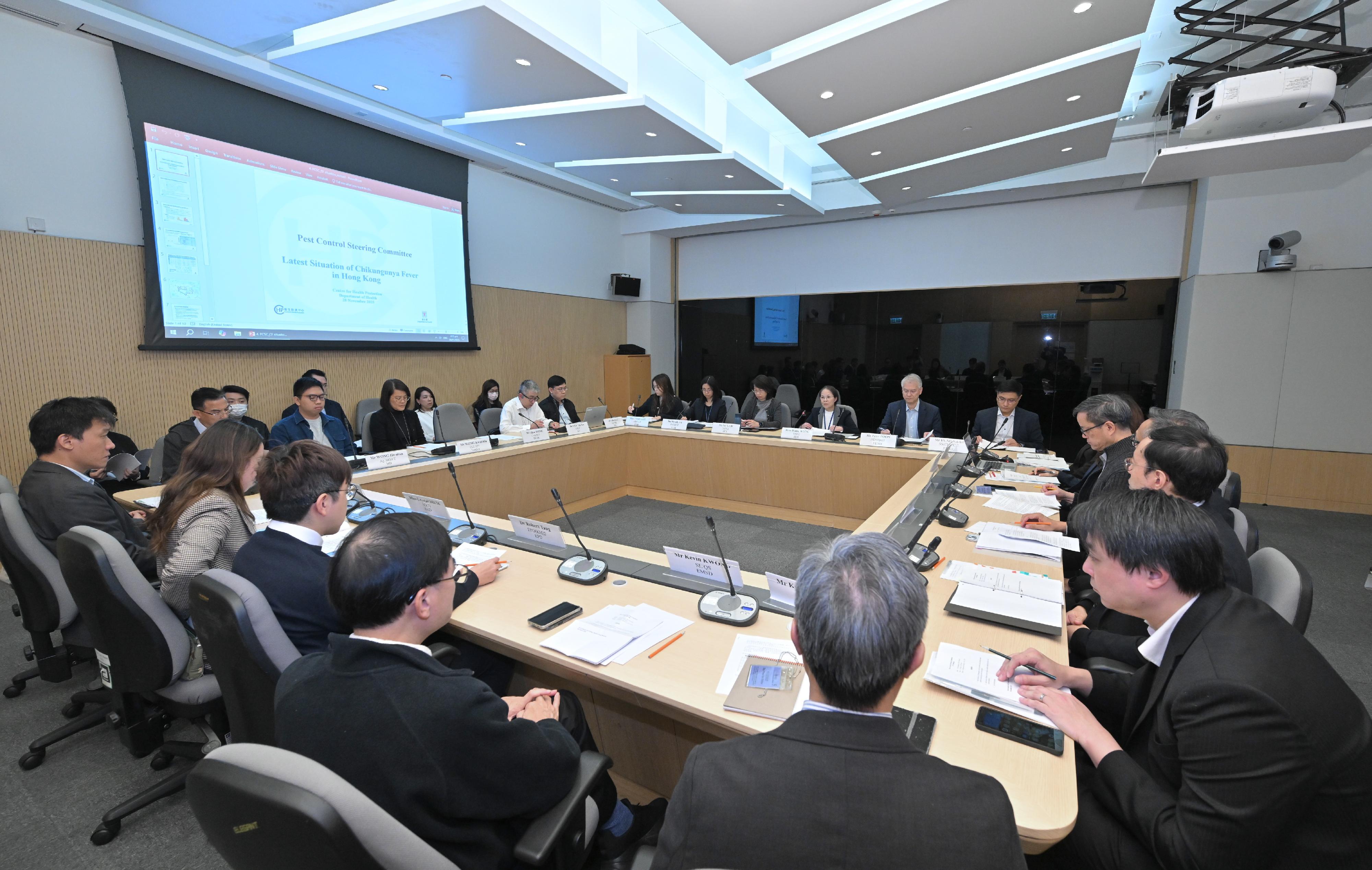



Pest Control Steering Committee reviews progress of preventive work against chikungunya fever and efforts in rodent control implemented by departments (with photo)
******************************************************************************************
Prevention and control of CF
Representative from the Centre for Health Protection (CHP) of the Department of Health (DH) presented the latest local, Guangdong Province and global surveillance data and risk assessment. The representative of the CHP also reported the results of epidemiological investigation into several cases recently recorded among residents of Tsing Yi, which revealed that the patients’ activities during the incubation and infectious periods overlapped in Tsing Yi North, primarily around Tsing Yi town centre and the Tsing Yi Nature Trails. As some patients of the confirmed cases have reportedly been bitten by mosquitoes while hiking along the Tsing Yi Nature Trails, the CHP considers the trails to be an area with higher risk. As a precautionary measure, the CHP urged individuals who have hiked in the Tsing Yi Nature Trails or the surrounding area since November 1 to seek medical attention as soon as possible if they develop relevant symptoms and to call the CHP's enquiry hotline (2125 2373). The CHP will assess symptomatic individuals and arrange blood tests if necessary.
In response to the cases recorded in Tsing Yi, follow-up actions have been taken by the Food and Environmental Hygiene Department (FEHD), which include:
- Upon receiving the CHP's notification, surveys of mosquito infestation will be initiated within 24 hours in areas within a 250-metre radius of the residence and workplace of the patient, as well as places the patient had visited during the incubation and infectious period. Relevant Government departments will be notified with the results for follow-up actions;
- Implementing larvicidal control measures in the target area and conducting fogging operations in nearby adult mosquito habitats to eliminate adult mosquitoes;
- Providing professional advice and technical support to relevant departments and stakeholders to assist in swiftly formulating and implementing effective mosquito control measures;
- Inspecting construction sites and private residences, and taking enforcement actions against violations related to mosquito breeding;
- Visiting schools and childcare facilities in the target area to provide information and assistance regarding mosquito prevention; and
- Enhancing public education efforts through organising health talks, setting up mobile education stations, and distributing publicity leaflets.
Specifically targeting confirmed cases who visited the Tsing Yi Nature Trails or the surrounding area, the FEHD has been conducting intensive fogging operations to eliminate adult mosquitoes along the hiking trails to eliminate adult mosquitoes since November 13. At suitable locations, large ultra-low volume foggers have been deployed, and robot dogs are being trialed to enhance operational effectiveness. The FEHD has also set up new mosquito trapping devices, cleared discarded containers and garbage that could bring stagnant water, and applied larvicide oil or larvicides in areas with stagnant water that cannot be removed immediately. Pamphlets have been also distributed to hikers in the area, urging citizens to be vigilant against mosquito infestations.
The FEHD has earlier requested the Kwai Tsing District Office, the District Lands Office of Tsuen Wan and Kwai Tsing, and the Drainage Services Department to strengthen efforts in eliminating potential mosquito breeding sites along the Tsing Yi Nature Trail.
The District Environmental Hygiene Superintendent (Kwai Tsing) of the FEHD also held a meeting of the inter-departmental task forces on anti-mosquito work across districts today, to discuss the latest developments regarding the situation and plan accordingly to coordinate relevant departments and stakeholders in strengthening mosquito prevention and control measures in areas under their purview.
In addition, in terms of the overall risk assessment, although the northern hemisphere is about to enter winter, some subtropical regions are still experiencing higher-than-normal temperatures due to climate change, creating suitable conditions for mosquito breeding. In addition, the outbreaks of CF in tropical regions are ongoing. Therefore, the risk of imported cases persists.
Representatives from the FEHD reported to the PCSC the latest situation of mosquito proliferation. The gravidtrap indices for Aedes albopictus for October 2025 was 2.2 per cent, lower than the 2.5 per cent recorded in September. In October, all 64 survey areas recorded an area gravidtrap index lower than the alert level of 20 per cent. In addition, the monthly density index for Aedes albopictus in October was 1.2, which represented that an average of 1.2 Aedes albopictus adults were found in the Aedes-positive gravidtraps, indicating that the number of adult Aedes albopictus was not abundant in the survey areas.
Aedes albopictus eggs are resilient in cold and dry conditions, and upon exposure to suitable temperature and water, the eggs could still hatch into adult mosquitoes. To prevent the local transmission of CF, all government departments and the community must continue to maintain effective mosquito prevention and control measures in place during the winter season, ensuring the removal of potential breeding grounds and thorough clearance of mosquito eggs. In view of the situation at the Tsing Yi Nature Trail, relevant departments will also remind their staff to pay special attention to mosquito control efforts along hiking trails and similar areas.
Rodent control
The FEHD presented the results of its rodent activity surveys conducted in various districts during the first half of 2025. The findings indicated that the overall RAR was 96 per cent. Compared to the RAR recorded in the second half of 2024, 16 out of the 19 surveyed districts (approximately 84 per cent) showed an increase in their RAR, reflecting an improvement in rodent conditions.
In the meeting, the FEHD introduced how to effectively utilize the RAR data to formulate more targeted measures, further enhancing the effectiveness of rodent control efforts. In addition, the FEHD continues to carry out strategic rodent control actions in 93 major rodent black spots, reallocating resources to comprehensively and continuously mitigate the rodent infestation in the relevant black spots. It is estimated that the target of reducing the number of hotspots by 60 per cent can be achieved by the end of 2025.
In addition, the Housing Department (HD) and the Leisure and Cultural Services Department (LCSD) also reported in the meeting rodent prevention and control measures implemented in venues and areas under their purview.
In the meeting, the LCSD reported the latest rodent situation in San Po Kong Sitting-out Area. With the support from the FEHD, the LCSD will continue to implement rodent prevention and control measures. To date, a total of 23 rodents have been caught or found dead at the site. In addition, the LCSD is preparing enforcement actions against feeding of rodents and related acts that soil public areas in collaboration with other departments. Furthermore, the FEHD will shortly install thermal imaging cameras at the location to monitor rodent activity and assess the effectiveness of control measures. The site will also be included in the Rodent Activity Survey for 2026, in accordance with established criteria and priorities.
The effectiveness of prevention and control of rodents relies on the co-operation of stakeholders from various sectors. The Environment and Ecology Bureau will continue to co-ordinate the Cross-sectoral Territory-wide Anti-rodent Action to promote cross-sector, multidisciplinary and community involvement to comprehensively control rodent together. The FEHD launched the first phase of the Anti-rodent Charter (the Charter) targeting residential premises in December 31, 2024, to promote residents' awareness of environmental hygiene and encourage them to cultivate good habits for a rodent-free environment. As of November 25, 2025, 684 residential premises have signed the Charter, covering around 650 000 households. Among the residential premises, two are participants of the Pilot Scheme on Joint Property Management, covering more than 40 households. Other participants of the Pilot Scheme on Joint Property Management will be invited to sign the Charter when they are ready.
The Under Secretary for Environment and Ecology and the Chairperson of the PCSC, Miss Diane Wong, urged at the meeting all departments to closely monitor situation of mosquito proliferation in areas identified as high risk, and strengthen mosquito elimination work in areas under their purviews. Regarding rodent infestation, Miss Wong emphasised interdepartmental collaboration and public participation are important to combating rodent infestation. Various departments should proactively consolidate the rodent control work with various sectors and encourage the public to collaborate in rodent prevention and control actions.
The meeting today was chaired by Miss Diane Wong. Government bureaux, departments and organisations attending the meeting were the Agriculture, Fisheries and Conservation Department; the Architectural Services Department; the Civil Engineering and Development Department; the Development Bureau; the Department of Health; the Drainage Services Department; the Education Bureau; the Electrical and Mechanical Services Department; the Environmental Protection Department; the FEHD; the Government Property Agency; the Hospital Authority; the Home Affairs Department; the HD; the Highways Department; the Lands Department; the LCSD; the Marine Department; and the Water Supplies Department.
Ends/Friday, November 28, 2025
Issued at HKT 22:48
Issued at HKT 22:48
NNNN
Photo